 English
  Português do Brasil
  Español
  简体中文
简体中文 
Have you ever wondered how corn by-products are obtained? Among them cornmeal, starch, corn flour, grits, flakes, flakes and several others?
The corn milling process is fundamental to food production and is one of the main sources of savings in many developing countries. Corn grain is transformed into flour, flake, cornmeal, grits and starch, among other edible products, through a milling process that involves several steps.
Corn milling starts with selecting the highest quality corn kernels. Corn is usually stored in silos before being ground. Next, the corn is cleaned to remove impurities such as stones, chaff and dirt.
After cleaning, the corn is unloaded into the mill, where it is crushed between milling rollers to produce flour. The flour is then separated from the husk and the germ of the corn through equipment that performs the separation and sieving.
The next step in the corn milling process is the direction of the by-products, as they are obtained, be it flour (cornmeal), grits, flakes, starch, among others.
At that time, having a flexible industry allows obtaining several variants of by-products, according to the commercial needs of each customer.
In addition to the production of corn flour, cornmeal and starch, the corn milling process is also used to obtain brewer's grits. Brewer's grits are a form of ground corn kernels that are used as a basic ingredient in brewing beer.
The production of brewer's grits is similar to the cornmeal milling process, but the corn kernel is ground in a different way to produce a coarser texture. Brewing grits are then processed with water that is added to the beer during the brewing process.
The use of brewer's grits in beer production is important because it provides starch and sugars necessary for beer fermentation. In addition, brewer's grits also add flavor and color to the beer.
It is also possible to obtain corn flake, the corn flake production process starts with the selection of high quality corn kernels and cleaning to remove impurities. Next, the corn is husked and degerminated, leaving only the endosperm of the grain. The endosperm is then processed in special equipment to produce corn flake, such as the TITANIUM Laminator.
Another product that can be obtained from the process is cornflake, which is used as a base ingredient for the production of couscous. Corn flakes are produced from high quality grains and require efficient separation, degerming and cleaning.
Corn flakes are a versatile form of ingredient that can be used to make couscous, cakes, breads and other foods.
The difference between corn flakes and corn flakes is the way the grain is processed. While corn flake is ground with more pressure to produce a fine, even texture, corn flake is ground with less precision and pressure to produce a coarser, flaky texture.
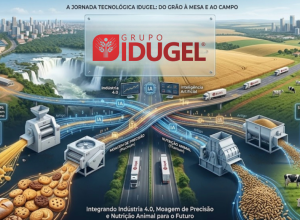
In order for this process to work properly, profitably and produce high quality products, it is necessary to have high quality milling equipment. And that's where the Idugel Group comes in, leader in the corn milling equipment market.
Grupo Idugel offers a wide range of equipment for corn milling, from reception, cleaning, transport, grinding, separation, sieving, and filling, with equipment for all types of customers and capacities.
All equipment is designed with state-of-the-art technology and manufactured with high quality materials to ensure the efficiency and durability of the milling process with a much faster payback than what is normally found on the market.
In addition, the Idugel Group offers technical support and maintenance services to ensure that the equipment works correctly and produces high quality products.
Specialized technicians are always available to help with any technical issues or queries about the corn milling process.
The equipment has facilitated maintenance systems aimed at reducing downtime and spare parts are in stock for prompt delivery.
The Idugel Group also offers customized solutions to meet the specific needs of each client, from small producers to large agri-food industries.
We understand that every customer has unique needs and we work with each one to ensure they have the ideal equipment for their needs.
Grupo Idugel equipment is designed with safety in mind, and includes features compatible with major national (Nos) and international (ISO) standards, such as overload protections, protected access and emergency stop devices, and measurement of temperature and volume of production.
In addition, our equipment is easy to use and maintain, which ensures continuous, trouble-free operation.
The Idugel Group is also concerned about the environment and designs energy efficient equipment to reduce its environmental impact. We also offer product options without the need to use a drying process, which makes the environmental impact very low compared to what is normally offered on the market.
In short, if you're looking for a customized solution with a quick return on investment, contact us today to learn more about how we can help you achieve industry leading edge.
Whatsapp: (49) 35519400
Sales Schedule: (49) 9 99645451
Summary of the corn industrialization process:
Complete guide on the corn milling process and its derivatives:
- Selection of high quality corn kernels and pre cleaning;
- Grain cleaning and classification;
- Degermination of corn grains;
- Grinding/Processing of degerminated corn grains;
- Separation and final classification;
- Drying and packaging of the products obtained
Obtained Products:
- Cornflour
- Precision grinding of corn kernels to produce a fine, uniform texture.
- Corn meal
- Grinding corn kernels with precision to produce a coarser texture than cornmeal.
- Starch
- Precision processing of corn grains to produce a fine texture and characteristics (solubility, texture, thermal stability and gelling).
- brewing grits
- Processing corn kernels to produce a coarser texture.
- corn flakes
- Precisely rolling corn kernels to produce a fine, uniform texture with “flake” generation.
- corn flake
- Processing corn kernels less precisely to produce a coarser, flakier texture.